
RAILWAY OPERATIONS I TRANSPORTATION
Helping freight rail teams make faster, safer decisions.
In partnership with a large freight rail operator, this work helps teams running busy freight yards make fast, confident decisions when conditions are constantly changing - bringing clarity to what trains are coming into the yard and what needs attention next.
Company name has been fictionalized to protect client NDAs.
Problem Overview
Running one of North America’s busiest freight networks with old-school DOS-style technology.
Freight rail yards are massive industrial hubs where trains are sorted and dispatched across the country. The teams running them make high-stakes, real-time decisions all day. They decide which trains to prioritize, where bottlenecks are forming, what needs attention now versus later.
The client, a major North American freight rail operator, was making these decisions using command-line terminals from the past. They were dealing with an outdated interface, text-heavy black screens, no visual hierarchy, and no clear error states. Users navigated just by memorizing commands. That knowledge lived in people's heads, but not in the system.
The client was undertaking a major modernization initiative - a multi-year program spanning multiple work streams - to move its operations onto a modern platform. The Yard Management module was deliberately designed first, to deliver early, tangible value while the larger transformation was still getting underway.
My role & responsibilities
Lead UX Designer
I was brought in as part of a cross-functional team for Phase 1 of the project.
I ran discovery sessions with stakeholders to reverse-engineer the logic of a system that had never been fully documented, designed across a highly complex operational environment, managed the Phase 1 design and development handoff, and took ownership of the work stream.
Duration
4 months

What primary research showed us
To understand the real problem, the team spent 40+ hours shadowing operators in active yards, ran 8 user interviews across 4 job roles, and documented over 100 pain points, and 4 critical themes.
Operators were juggling up to 4 screens simultaneously just to complete a single task, thereby increasing time to complete an action. There was also no easy way to move between views without losing context, and that increased the chance of errors.
Another significant challenge was that of adoption. Many experienced operators had spent years mastering the old system. They were fast, confident, and comfortable with it. Adoption of anything new wasn't guaranteed.
In addition, because the same task was done differently by different people, shift handovers were already a risk. Therefore a new system that wasn't immediately intuitive would only make that worse.
What we delivered
Inbound Train Lineup + Train Details Screens
These screens give operators a clear, forward-looking picture of what's coming into the yard. The Inbound Lineup screen shows which trains are arriving, where they're coming from, when they're expected, and which track they'll arrive on. One click takes teams into the Train Details screen, a consolidated view of train and engine specs, and a full car-level breakdown, replacing the multiple legacy screens operators previously had to juggle simultaneously.
Yard Summary Screens
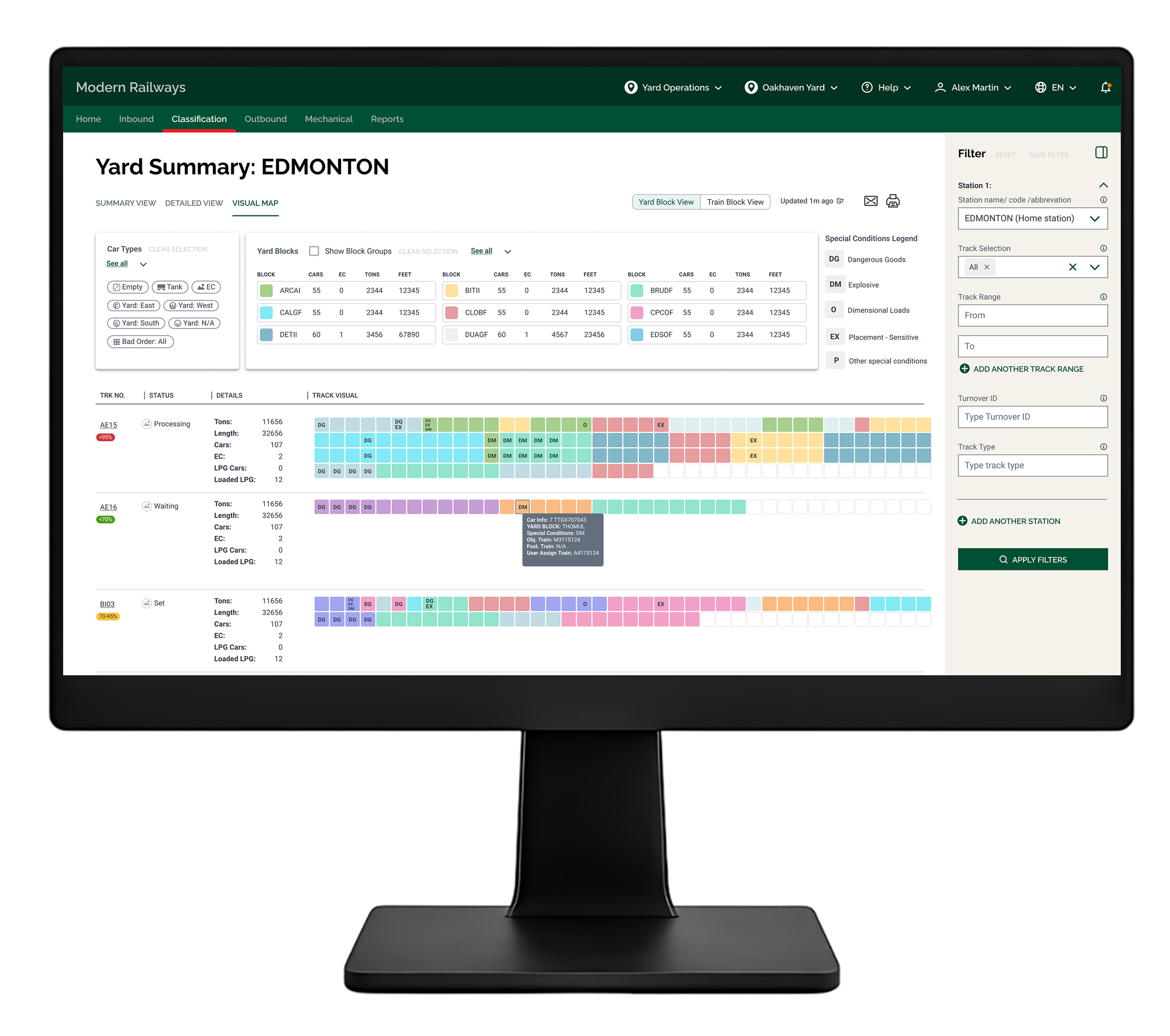
Three switchable views giving teams a real-time picture of what's actually in the yard. The Summary View shows how cars are distributed across tracks, where hazardous or inspection-required cars are concentrated, and which areas are flowing smoothly versus getting blocked. The Detailed View lets planners drill deeper into specific tracks. The Visual Map gives a spatial, colour-coded picture of the entire yard at a glance. A filtering system, ability to add comments, and share via email were built in to solve the shift handover problem.
Where it landed
Designs for this phase are being built and piloted, laying the foundation for more consistent, system-supported decision-making as the platform evolves.
While this project is a part of a much larger multi-year rollout, the initial phases changed how yard conditions are understood and discussed. Instead of piecing information together across systems, teams can start from a shared, up-to-date view of what’s coming into the yard and what needs attention right now. Conditions like congestion, risk, and readiness are surfaced earlier, making prioritization clearer and conversations more focused.
Full case study is password-protected. Request Access here